
Heavy-Duty Truck Steering Diagnostics: A Technical Sourcing Guide for Scania Drag Link 1343262
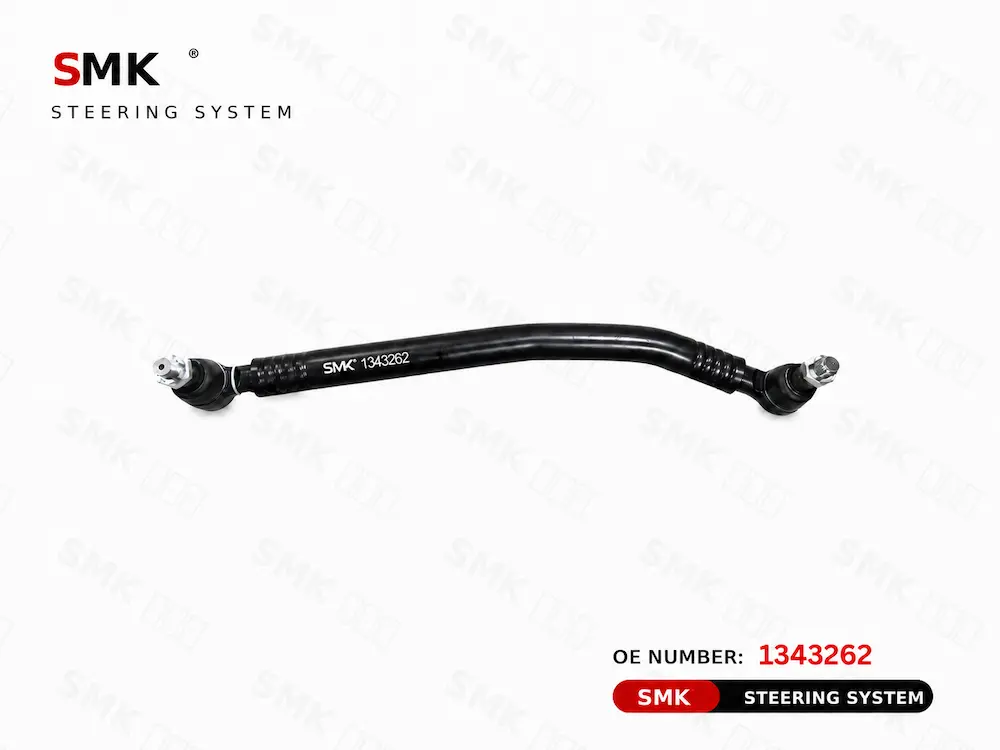
In commercial fleet operations, steering precision is not merely a matter of driver comfort—it is a critical variable governing fleet safety, tire overhead, and operational uptime. For heavy-duty vehicles like the Scania P-, G-, R-, and T-series, the steering linkage system continuously absorbs massive lateral forces and high-frequency road vibrations. At the center of this system is the steering drag link, which serves as the mechanical bridge transferring directional input from the pitman arm to the steering knuckle.
When this component suffers internal wear, the entire handling dynamic of the truck degrades. For procurement managers and fleet maintenance directors, choosing a premium aftermarket replacement like the SMK Steering System is the definitive strategy to mitigate mechanical risk and control total cost of ownership (TCO).
1. Critical Symptoms of Drag Link Failure in Scania Fleets
A compromised or worn drag link does not fail silently. Because it governs the exact steering angle of the front wheels, internal play within the ball joints will manifest via specific mechanical indicators that require immediate engineering attention.
-
Excessive Steering Wheel Vibration & Shuddering: As the internal bearings within the drag link ball joint degrade, the front wheels oscillate slightly at high speeds. This transmits an intrusive vibration up through the chassis and into the steering wheel, particularly noticeable at highway cruising speeds (80 km/h+).
-
Persistent Vehicle Pulling & Lane Wander: A failing drag link breaks the rigid connection required to lock wheel alignment. Fleet drivers will experience a “dead zone” or loose steering feel, forcing them to constantly adjust the wheel to keep the truck centered, causing severe driver fatigue.
-
Accelerated or Uneven Tire Wear: When the drag link allows one tire to drift out of its geometric alignment parameter, that tire scrubs against the pavement. This lateral friction rapidly destroys the tread, concentrating wear on the inner or outer shoulder and triggering premature tire replacement expenses.
2. Engineering Specifications & Structural Integrity: The SMK Standard
To guarantee exact 1:1 original equipment compatibility and superior durability under high load factors, the SMK Steering System manufactures its premium drag links to exact structural thresholds.
The structural blueprint of this component can be verified directly in the reference file 1343262.jpg, showcasing the precise geometry and heavy-duty design executed by SMK.
SMK 1343262 Technical Specification Matrix
| Engineering Parameter | Specification Value | Industrial Sourcing Standard |
| OEM Reference Number | 1343262 | Scania Heavy Duty Standard |
| Total Components Length | 608 mm | Direct OES Interchangeability |
| Pipe Outer Diameter (Ø) | 42 mm | Reinforced Wall Thickness |
| Cone Size / Taper | 26 mm | Precision Machined Seating |
| Outer Thread Dimension | M20 x 1.5 | High-Torque Hardened Thread |
| Body Manufacturing Process | One-Piece Hot Forged Steel | SAE 1045 Structural Carbon Steel |
| Sealing Boot Material | CR (Polychloroprene) Rubber | All-Weather Thermal Stability (-40°C to 120°C) |
Technical Description: The table above outlines the exact dimensional boundaries and material specifications of the SMK Drag Link 1343262. By utilizing a 42mm reinforced pipe diameter and hot-forged carbon steel, the SMK component provides unmatched resistance against bending and torsional stresses compared to standard cast-iron or thin-walled aftermarket components.
3. The B2B If-Then Risk Mitigation Framework
Commercial procurement operations cannot afford to buy components based on low-tier pricing structures alone. Mechanical failure on a transcontinental logistics route incurs catastrophic operational penalties. Use this professional engineering framework to evaluate your replacement sourcing:
-
IF your Scania commercial vehicles operate under maximum payload configurations or travel through severe environments (e.g., construction sites or mining infrastructure), THEN you must specify a drag link built via hot-forged steel processing, because lower-grade cast alternatives contain micro-porosities that propagate under cyclic loading, leading to catastrophic structural cleavage.
-
IF your fleet operates in regions subject to extreme temperature fluctuations or heavy winter road-salting protocols, THEN the drag link must be equipped with a high-grade Polychloroprene (CR) sealing boot, because standard nitrile or commercial PVC boots fracture under thermal stress, allowing moisture and road grit to contaminate the internal lubricant matrix and destroy the ball joint within months.
-
IF you are planning a multi-unit fleet maintenance overhaul across multiple service centers, THEN sourcing factory-direct 1:1 OE-matched SMK components prevents field installation delays, because dimensional variances as small as ±2mm in unverified aftermarket links cause systematic wheel misalignment and immediate tire scrubbing.
4. Cross-Reference & Vehicle Fitment Database
To maximize procurement workflow efficiency, it is critical to cross-reference multiple part numbers within your digital asset management systems to ensure a seamless warehousing roll-out.
Scania System Compatibility Profile
| OEM Brand | Cross-Reference Part Number | Compatible Truck Series | Production Years Covered |
| SCANIA | 1343262 | P-, G-, R-, T-Series Truck | 2003 – 2019 |
| SCANIA | 1869413 | 4-Series Heavy Duty Truck | 1994 – 2008 |
| DT Spare Parts | 1.19366 | All Heavy Axle Applications | All Years |
| SAMPA | 097.669 | Front Axle (LHD Models) | All Years |
Technical Description: This cross-reference index validates that the SMK Drag Link matches the geometric performance profiles of several primary OEM and tier-1 tracking numbers. It confirms total coverage across both the iconic Scania 4-Series and the comprehensive P-, G-, R-, and T-series logistics lines, operating on a front axle Left-Hand Drive (LHD) setup.
5. Contextual B2B FAQ: Core Insights for Fleet Sourcing
What are the operational consequences of a complete drag link separation at high speed?
If a heavy-duty truck’s drag link separates completely while driving, the mechanical linkage between the steering gear and the front axle is entirely severed. The driver will instantly lose directional control over the front wheels, presenting an immediate rollover or collision hazard. Implementing high-fatigue components like the SMK Steering System prevents unexpected joint detachment by utilizing a high ball-joint pull-off force threshold.
Can a worn drag link initiate the commercial vehicle “death wobble”?
Yes. The extreme oscillation known in the commercial transport sector as the “death wobble” is heavily aggravated by internal play within the steering linkage. When a drag link’s ball-and-socket joint becomes loose, any road bump can initiate a harmonic vibration that shakes the entire front-end suspension. This issue is resolved completely by replacing worn components with tight, high-tolerance alternatives that feature zero internal deflection.
Why should forged steel be prioritized over cast metal for steering rods?
Forging aligns the grain flow of the steel along the exact contour of the steering link body. This directional grain structure maximizes the component’s yield strength and fatigue resistance. Cast components, conversely, feature non-directional grains and are highly susceptible to sudden fracturing under the intense lateral forces encountered during emergency braking or sharp cornering maneuvers.
How does the SMK dust boot extend the component life cycle?
The ball joint is highly vulnerable to dust, salt water, and grime. Once the protective boot splits, structural grease escapes and abrasive road grit moves in, grinding down the internal ball seat. SMK integrates professional-grade CR rubber boots that remain elastic and completely sealed under severe operational conditions, preventing contamination and multiplying the operational life cycle of the link.
Optimizing your heavy vehicle’s steering integrity is a non-negotiable metric for fleet risk management. Sub-standard steering components do not just jeopardize driver lives; they directly inflate operational overhead via rapid tire scrubbing and cause expensive unscheduled breakdown logistics. Upgrading your global inventory to SMK’s millimetrically calibrated 1343262 steering bars guarantees ultimate fleet mechanical endurance. Reach out directly to our global commercial sales division today to secure direct factory-level volume quotations, production schedules, and end-to-end maritime freight support.
Technical Sourcing & Industry Standards
- SAE International. SAE J403: Chemical Compositions of SAE Carbon Steels. Standard reference for SAE 1045 structural carbon steel verification.
- SAE International. SAE J491: Commercial Vehicle Steering Linkage Ball Studs and Sockets. Industrial benchmarking for ball joint pull-off force and cyclic fatigue testing.
- Gillespie, T. D. (1992). Fundamentals of Vehicle Dynamics. Warrendale, PA: Society of Automotive Engineers. Chapter 8: Steering System Dynamics and Wheel Shimmy Mechanics.
- Heißing, B., & Ersoy, M. (2011). Chassis Handbook: Fundamentals, Driving Dynamics, Components. Springer Vieweg. Technical comparison of forged steel vs. cast components under high-frequency load factors.
- ASM International. ASM Handbook, Volume 11: Failure Analysis and Prevention. Structural integrity analysis regarding metal fatigue in commercial vehicle suspension.
- ISO 1629. Rubber and latices — Nomenclature and classification. Material standard governing Polychloroprene (CR) rubber compound thermal boundaries (-40°C to 120°C).